
Office Screens vs Office Partitions: Which Do You Need?
Posted by Panelscreens on 2nd Oct 2026
Posted by Panelscreens on 2nd Oct 2026
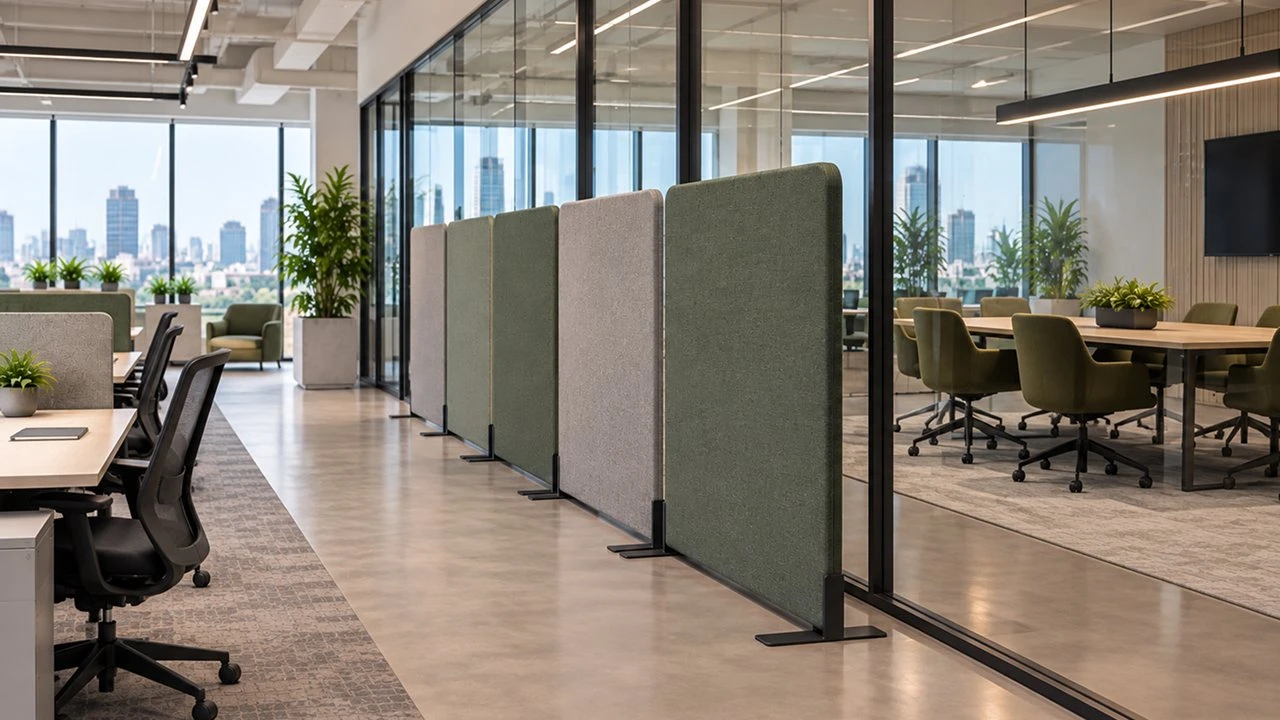
Office screens are freestanding panels you can put in place in minutes and move whenever you like. Office partitions are fixed walls, usually floor to ceiling, built by a fit-out contractor. If you want to divide space quickly and keep it flexible, choose screens. If you need a closed room that stops sound passing through, you need a partition.
This guide explains the difference, what each costs you in time and disruption, and when to use one, the other or both. You can browse our full range of office screens and partitions as you read.
Office partitions are internal walls. They are usually glass, plasterboard or a mix, run from floor to ceiling, and are fixed to the building. They create separate rooms such as meeting rooms and private offices.
Because they are part of the building, partitions take planning and installation, and may need your landlord's consent. Once in, they are hard to move.
Office screens are freestanding panels that stand on their own feet. There is no building work and nothing to fix, so you can divide a space the day they arrive and rearrange it later.
They come in fabric, acoustic, glazed, wipe-clean vinyl and wooden finishes. Many can be linked together into longer runs, and mobile screens on castors roll to wherever they are needed.
Need something between the two? Our free-standing office partitions stand up to 2000mm high, link into partition walls of any length and need no building work.
| Office screens | Office partitions | |
|---|---|---|
| Installation | Unpack and stand in place | Built in by a contractor |
| Disruption | None | Building work in the office |
| Flexibility | Move or reconfigure any time | Fixed once built |
| Sound | Acoustic screens absorb noise in an open space | Closed rooms block sound between spaces |
| Cost | Lower, no installation needed | Higher, includes design and fitting |
| Best for | Zoning open-plan areas, quiet corners, waiting areas | Meeting rooms and private offices |
If you need a closed space without building work, a freestanding office pod or phone booth sits between the two.
Many offices use both. Partitions create the meeting rooms, and screens divide the open-plan floor between them. Screens also work inside large partitioned rooms, for example to separate teams in a big training room.
To divide a larger area, many screens can be joined with connectors into straight runs, corners and T-shapes. Our screen connectors link 2, 3 or 4 screens together. Some ranges are designed to stand alone, so check the product page before planning a run.
Screens are freestanding panels you can move at any time. Partitions are fixed, usually floor-to-ceiling walls that create separate rooms.
No. Freestanding office screens stand on their own feet, so there is no drilling or building work.
No. Acoustic screens absorb sound and make an open office calmer, but they do not seal a space. For full privacy, use a closed room or an office pod.
It depends on the range. Our Edge Fabric 38 freestanding screens, for example, come in heights from 800mm to 1800mm.
Not sure what your office needs? Contact our team, Monday to Friday, 9am to 4pm.
Related reading: Office room dividers: which type do you need?
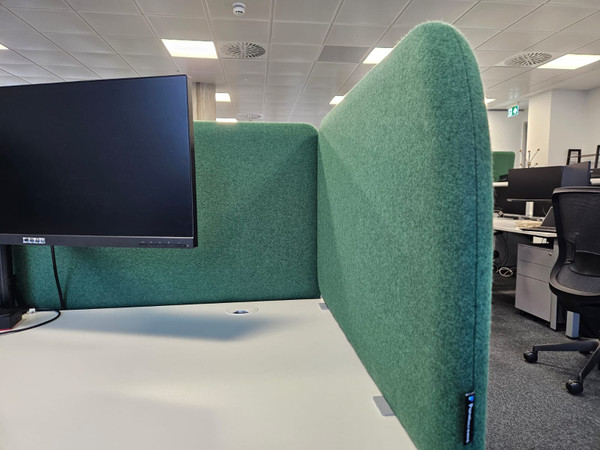 Case Study: Bespoke Acoustic Desk Screens for Vorwerk