
Ceiling Noise Is Probably Your Biggest Problem, Not the Walls
Posted by Panel Screens on 7th Sep 2026
Posted by Panel Screens on 7th Sep 2026
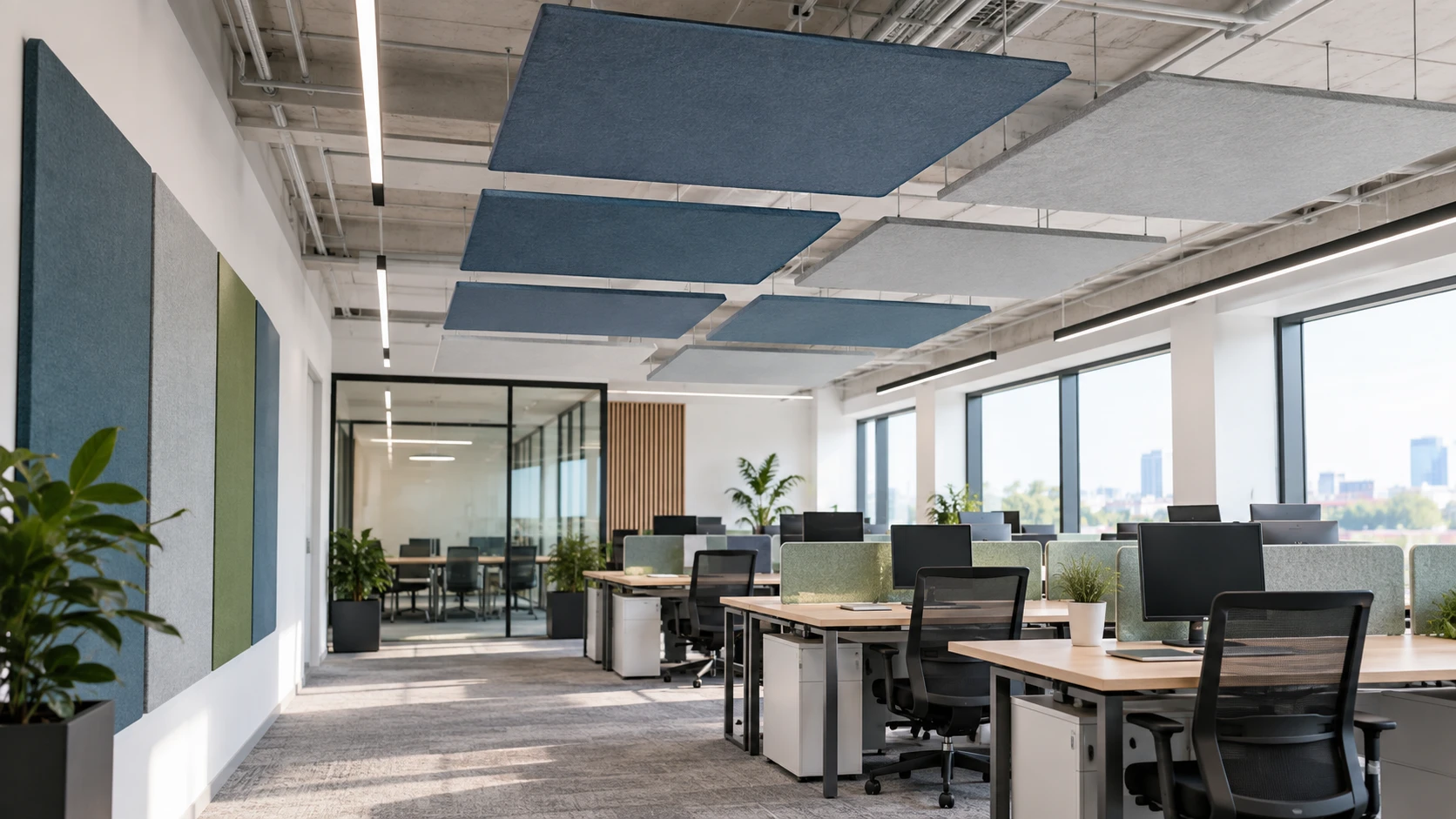
Most offices that try to fix noise start in the same place. A few wall panels go up, maybe a rug gets added, someone hangs a heavier curtain near the meeting room. All reasonable moves, and all aimed at the wrong surface. In a typical open plan office, the ceiling is doing far more damage than the walls ever will, and it's usually the one part of the room nobody thinks to treat.
It's an easy thing to miss. Walls are right in front of you, easy to point at and easy to add something to. The ceiling just sits there, mostly ignored, until you actually stop and think about how sound moves through a room.
Sound doesn't travel in a straight line from one desk to another. It bounces. In a room with a hard, flat ceiling, most of that bounce happens overhead, and it happens over and over. A voice leaves someone's desk, hits the ceiling, reflects back down, hits it again, and keeps building until the whole room feels louder than any single conversation actually is. That build-up is called reverberation, and it's the reason an office can feel noisy even when nobody in it is being particularly loud.
The ceiling is also, in most offices, the largest unbroken surface in the room. Walls are interrupted by windows, partitions, cupboards, and doorways, all of which limit how much untreated wall surface actually contributes to the noise. The ceiling rarely has any of that. It's one continuous plane stretching across the whole floor, which is exactly why it's the biggest source of noise buildup rather than a secondary factor.
Wall panels aren't a waste of money. They genuinely help, especially near desks that sit close to a wall, or in smaller rooms where reflections have less space to build up before hitting someone's ears. The problem is what happens when they're the only thing an office invests in.
If the ceiling above an open-plan floor is still hard and untreated, sound keeps reflecting down no matter how many wall panels are fitted around the edges. The result is an office that's spent money on acoustics and still sounds much the same as before, which is usually when people conclude that acoustic treatment "doesn't really work," when actually the wrong surface was treated first.
If budget is tight, treat the ceiling before the walls, not instead of them. Get the biggest surface under control first, then use wall panels and sound insulation panels for walls to deal with the specific spots where reflections are still noticeable, usually corners, alcoves, and desks backed onto a solid wall.
Acoustic rafts are designed specifically for this. Rather than treating the entire ceiling surface, which isn't always practical in offices with lighting, sprinklers, ducting or a suspended ceiling already in place, rafts are suspended below the ceiling in a grid or cluster pattern. Sound hits the exposed surface of each raft and gets absorbed before it has a chance to reflect back down into the working area.
That makes them a genuinely practical option for offices that can't strip out and replace an entire ceiling, which is most of them. They install without major building work, they can be arranged to cover the busiest parts of the floor rather than the whole space uniformly, and they tend to have a far more noticeable effect on how a room actually feels than the same budget spent entirely on wall panels would.
They also do something wall treatment can't manage alone. Because they hang below the ceiling rather than sit flush against it, rafts capture sound from a wider range of angles, which matters in open-plan offices where conversations happen from every direction at once rather than in one predictable line.
None of this means walls should be ignored, or that acoustic screens and partition solutions don't have a place. A well-treated office usually ends up using a mix, rafts overhead to deal with the main source of reverberation, screens and desk dividers to manage sound at the point where people are actually sitting, and wall panels or sound insulation panels for walls in the areas where reflections are still a problem once the ceiling's been dealt with.
The mistake is starting in the wrong order. Treat the ceiling first, because it's doing the most damage, then use the smaller, more targeted products to clean up what's left. Offices that do it this way round tend to notice the difference straight away, rather than wondering why their new panels haven't changed much.
Yes. Rafts hang below the existing ceiling structure rather than replacing it, so they work well in offices that already have a suspended ceiling, ductwork or lighting they don't want to disturb.
It depends on the size of the space and how it's used, but rafts are usually concentrated over the busiest working areas rather than spread evenly across the whole ceiling, since that's where reverberation builds up fastest.
The ceiling, in most cases. It's typically the largest untreated surface and the main source of reverberation, so it tends to deliver a bigger improvement for the same spend than wall panels alone.
Yes, particularly near desks positioned against a wall or in corners, where reflections can still be noticeable even once the ceiling is treated. They work best as a follow-up step rather than the starting point.
No, and that's not really the goal. The aim is to reduce reverberation and background buildup so conversations and calls are easier to follow, not to remove all sound from the roo
© 2026 Panelscreens Limited | VAT № 316 0910 33


