Between homeworking and hot desking: How to approach office storage in 2021
13th Jul 2021
13th Jul 2021
2021 has brought the return of a familiar reality: the pandemic isn't over, and the shift in how we work is here to stay. What looked like a milestone toward "normal" a few months ago has become a clearer picture instead, a large part of 2021 will still be centered on homeworking.
For offices that are open or preparing to re-open, maximising efficiency is now a top priority, which is accelerating the already-growing shift toward hot desking.
With employees splitting time between home and hot desking setups, what does this mean for office culture and the sense of belonging? Stepping into the office after weeks of remote work, only to land at a generic desk with no personal items, no favourite mug, no desk plant, raises a real question for productivity and morale. Will output dip along with morale, or improve thanks to a more focused setup? It's a question worth taking seriously.
As offices focus on space efficiency and better resource allocation, hot desking has picked up momentum. Since many offices won't return to full capacity right away, a more compact layout is often a sensible way to cut operating costs.
Hot desking moves away from fixed personal workstations toward a shared-desk model. Desks and chairs act as flexible stations used by different employees at different times, in enclosed offices or shared coworking spaces. Beyond space savings, this setup is also designed to encourage more interaction and collaboration. For it to actually work, though, it needs careful planning.
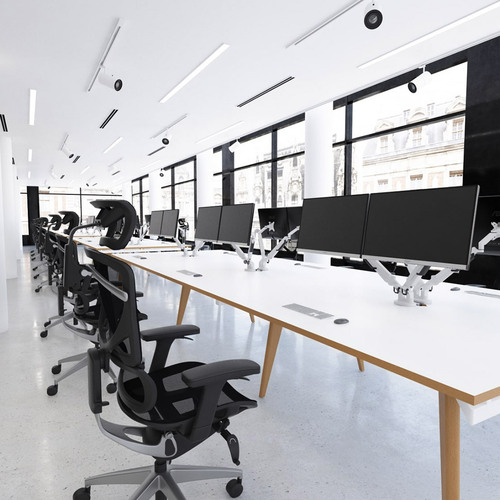
Undoubtedly, there are some clear benefits to this system and it can be a real driver of efficiency if employees buy into the idea and if it genuinely provides them with a comfortable and well equipped working environment. The key is to make each hot desking station a complete ecosystem that provides comfort, accessibility, connectivity and that is easy to plug in and out of, without extensive set-up.
There is nothing like coming into the office in the morning and having to set up your cables before you can plug in to your station. For efficiency and productivity, the set-up should be complete and only require a quick connection of the laptop to the docking station in order to gain access to power, internet connection and extension screens. A key element to ensuring the set-up stays in place and cables are not misplaced or removed is staying on top of cable management, by choosing adequate office desks with cable ports and support system.
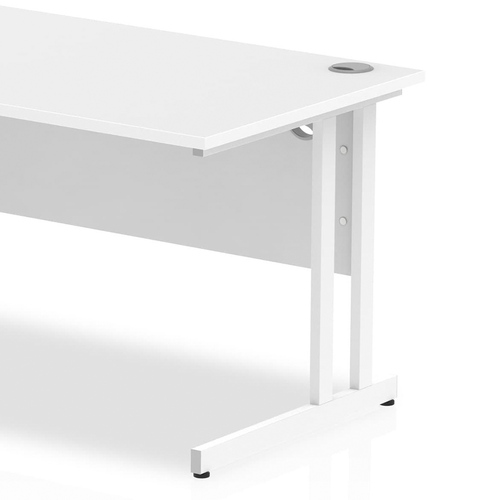
One of our best selling office desks that is ideal for setting up hot desking stations with great control of cable management is the Impulse White Rectangle Contract Office Desk With Cantilever Legs.
Impulse White Rectangle Contract Office Desk With Cantilever Legs
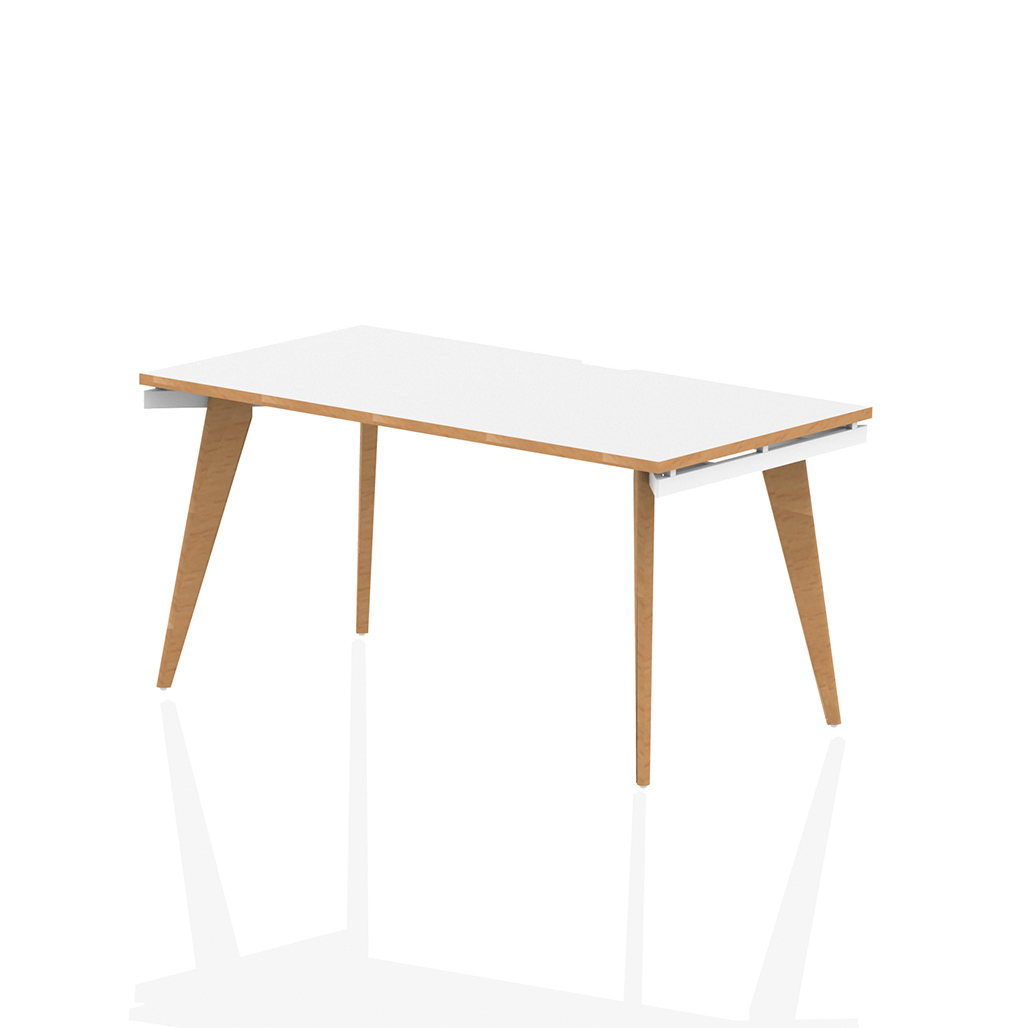
For a more elegant workspace, perfect for a stylish office or home use, there is also another approach to cable management. That is, opting for a contemporary design with a full, simple worktop and replacing the traditional circular cable ports with an under desk cable dumping system. Our Oslo Single White A-Frame Bench Home Office Desk is a perfect example and great choice for a hot desking station that provides the appeal of a more personal touch and welcoming office.
Oslo White A-Frame Bench Office Desk With Natural Wood Edge And Wooden Legs
When employees are using the hot desking stations on an ad hoc basis, you need to be able to cater to everyone’s needs. That is, the office chairs provided should take into consideration the fact that certain employees might have specific posture issues such as back pain, neck or shoulder problems and therefore will need to use an office chair that provides support in keeping a healthy posture.
The safest way to approach it is to opt for fully ergonomic office chairs that will allow your employees to minimise body pressure and increase their productivity. By popular demand, our recommendation is the Ergo Click Plus office chair with mesh seat and mesh headrest.
Ergo Click Plus Black Office Chair With Mesh Seat And Back With Headrest
Combining mesh seat with split backrest design and mesh headrest, the Ergo Click Plus office chair accommodates the body for an ideal working position and easy adjustments and provides auto-adjusting lumbar support.
A common concern and main reason for pushback from employees when it comes to hot desking is the lack of a personal touch on the workspace or a means of storing personal items. While there is always going to be a trade-off in this area, there are ways of making it feel personal, even when it isn’t.
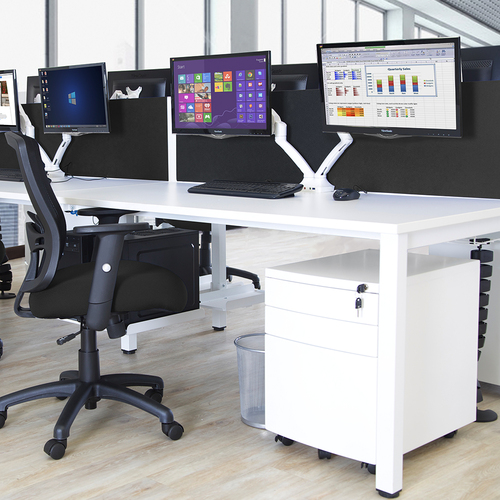
Depending on the number of stations and employees using the hot desking area, you can provide your staff with personal lockable pedestals or multidrawers that can be labelled and stored along the office walls or in a dedicated space. Mobile pedestals are ideal and can be easily moved from personal offices to co-working areas, depending on the needs.
Our Steel mobile filing pedestals with 5 casters offer great mobility, durability and particularly an adequate office storage solution for safe handling and storage of important files and documents, with its safe locking system.
Steel Mobile Filing Pedestal With 5 Casters, White Finish
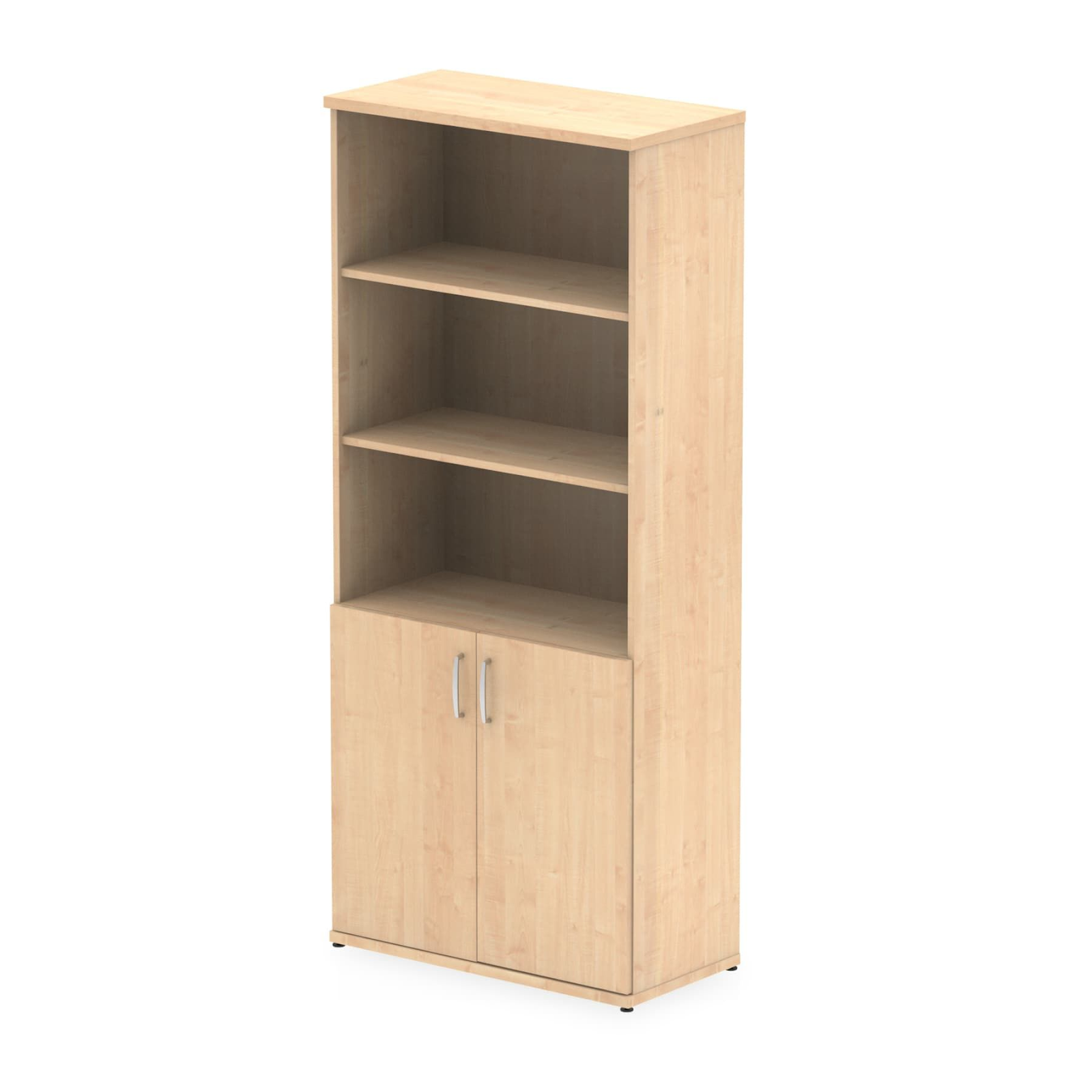
Open shelves storage cupboards, especially those with wood finish, have the advantage of taking away the industrial feel of steel storage cabinets. By adding open shelf cupboards to your office next to the hot desking area, you can store some generic items such as books or catalogues which will add personality to the space.
Impulse 2000 Open Shelves Storage Cupboard
Take it further and add some plants among them and that will contribute to creating a welcoming space, making the hot desking station feel more personal.
For many, office life has seen dramatic changes over the last year and is set to continue adapting and reacting to changes in our lifestyle. The key is to stay on top of it, predict changes, needs and preferences and quickly react to shifting trends. Therefore, adaptability is key, and so is adopting a strategy that is based on mobility and flexibility of your office layout.
A shared-desk system where employees use available workstations on an ad hoc basis instead of having a fixed desk.
Yes. Since desks aren't tied to one person, offices need fewer stations overall, which reduces the total footprint required.
A fully ergonomic chair with adjustable features, since it needs to comfortably support different body types throughout the day.
Lockable mobile pedestals are the most practical option, letting staff store personal items securely and move them between stations.
It works best in offices with fluctuating attendance, like hybrid or remote-heavy teams. Offices needing fixed, specialised setups may benefit less.
© 2026 Panelscreens Limited | VAT № 316 0910 33