
Acoustic Ceiling Panels for Offices: Clouds, Baffles or Tiles?
Posted by Panelscreens on 2nd Oct 2026
Posted by Panelscreens on 2nd Oct 2026

In most open-plan offices the ceiling is the biggest hard surface in the room, so it reflects more sound than anything else. Acoustic ceiling panels absorb that sound before it bounces back down, which cuts echo and makes the whole floor feel calmer. There are three main types: clouds, baffles and ceiling tiles.
This guide explains how each works, where it suits best and how to choose. You can browse our acoustic ceiling panels as you read.
Sound travels up from desks and conversations, hits a hard ceiling and reflects back across the room. In offices with concrete soffits, glass walls and hard floors, that reflected sound builds up into background noise and echo.
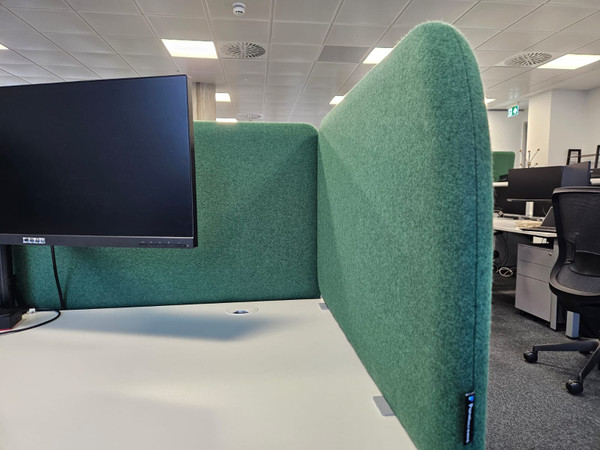
Ceiling panels absorb sound where it reflects most, without taking up any floor or desk space. They work best alongside acoustic desk screens, which absorb noise at source.
Ceiling and wall treatment work best together. For the walls, see our acoustic wall panels buyer's guide.
Clouds, also called rafts, hang flat and horizontal below the ceiling on suspension wires. They work well over desks, meeting tables and breakout areas, and can be grouped in different shapes and colours as a design feature.
Our Cloud ceiling panels come with a four-part suspension kit and are 40mm thick, with a 64mm option. See also our acoustic rafts.
Baffles hang vertically from the ceiling in rows. Because both faces absorb sound and they take up little ceiling space, they suit high or exposed ceilings where ducts, lighting and sprinklers are already in place. Our Abstracta Basic ceiling baffles come with a wire kit for mounting.
Ceiling tiles sit in or hang just below an existing suspended ceiling. Our Square sound-absorbing ceiling tiles are 64mm thick, with optional ceiling grid twist clips, and can also be hung on their own suspension kit.
Many ceiling panels are tested for NRC (noise reduction coefficient), from 0 to 1. The higher the number, the more sound the panel absorbs. For example, our 64mm Square ceiling tiles are rated NRC 0.90, a Class A sound absorption rating, and our 40mm Cloud panels are rated NRC 0.55. Thicker panels generally absorb more.
| Type | How it hangs | Best for |
|---|---|---|
| Clouds and rafts | Flat, suspended on wires | Over desks, meeting tables and breakout areas |
| Baffles | Vertical, in rows | High or exposed ceilings with services |
| Ceiling tiles | In or below a suspended ceiling grid | Offices that already have a grid ceiling |
| Acoustic lighting | Pendant light with an acoustic shade | Adding absorption where lights already hang |
Our Cloud, Square and Doughnut ceiling panels are made to order in the UK in a choice of fabrics. Our Square tiles, for example, come in Macflex, Camira Cara, Camira ERA and Camira Blazer. Mixing two or three colours is a simple way to add a design feature. We recommend ordering free fabric samples first, as screen photos are not colour-accurate.
Yes. They absorb sound that would otherwise reflect off a hard ceiling, which cuts echo and background noise across the room. They do not stop sound passing between rooms.
Clouds hang flat and horizontal, so they cover an area like a floating ceiling. Baffles hang vertically in rows, absorb sound on both faces and suit high or exposed ceilings.
Most hang from the ceiling on a suspension or wire kit, which is supplied. Ceiling tiles can also clip into an existing grid.
Yes. Our Cloud, Square and Doughnut panels are made to order in the UK, with special sizes available on request. Contact our team with your room sizes.
Not sure what your ceiling needs? Contact our team, Monday to Friday, 9am to 4pm.
Related reading: Do acoustic panels work?
 Case Study: Bespoke Acoustic Desk Screens for Vorwerk